Few phrases are invoked more casually in Second Life Gor than “BtB”, a shorthand way to say By the Book.
It is often used as a shield, sometimes as a weapon, and just as often as an excuse. When challenged on conduct or custom, a quote is produced, presented as proof, and the matter is declared closed. When contradictions arise, the conclusion offered is not that the quote was misapplied, but that BtB Gor itself is impossible.

That conclusion is false.
Being BtB does, in fact, mean adhering to what is written in the books. It does not mean lifting isolated passages out of their setting and applying them universally across a world that was deliberately written as regional, fractured, and culturally distinct.
Gor is not a monoculture.
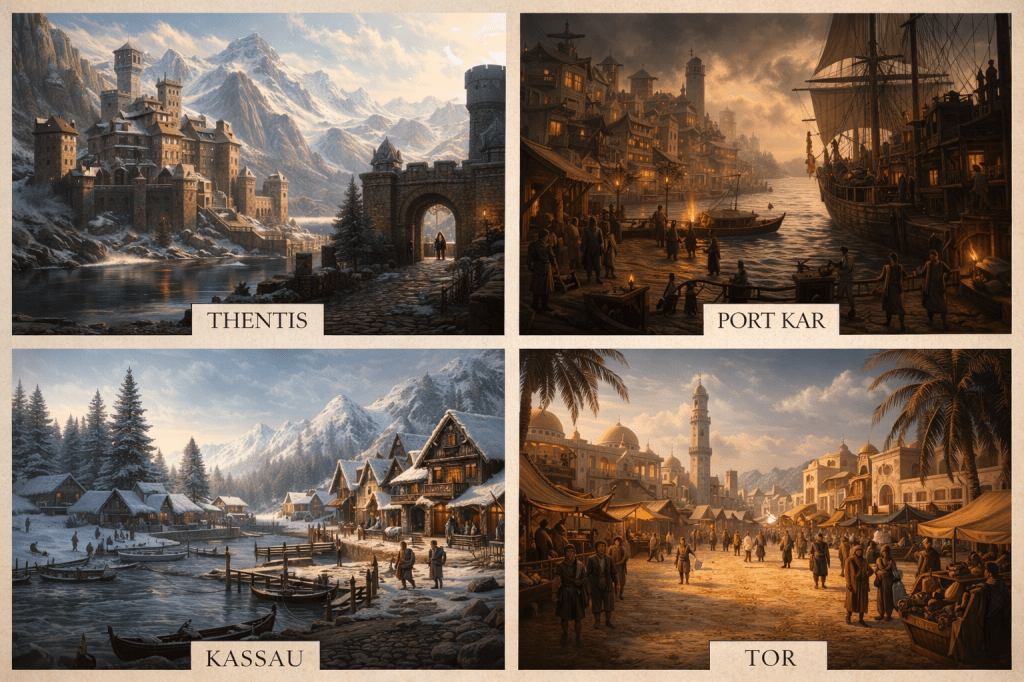
A practice described in Thentis does not automatically belong in Port Kar. A custom tolerated among the wagon peoples does not grant license in Ar. What is accepted in Kassau may be forbidden in Tor. Even cities that share geography, climate, or trade routes often differ sharply in law and expectation.
These differences are not contradictions. They are design.

The books present Gor as a world of city-states, each shaped by its economy, history, and power structures. Port Kar is a pirate city governed by different incentives than Thentis, a merchant hub with civic order and institutional law. To pull a quote from one and enforce it in the other is not BtB fidelity. It is careless flattening.
When quotes are stripped of context, confusion follows.
Players begin importing customs wholesale. Northern practices appear in southern streets. Port laws are enforced inland. Cities lose coherence, not because BtB is unworkable, but because it is being misused as a universal permission slip.
This is what leads people to say, “It is not possible to RP BtB Gor.”
What they often mean is that BtB Gor cannot be reduced to a single ruleset that applies everywhere.
That is correct. It was never meant to.
BtB Gor is not about sameness. It is about accuracy.
It is entirely possible to have a southern city that observes southern norms. It is entirely possible to have Thentis, Port Kar, Kassau, and Tor all operating BtB while remaining distinct. The books allow this. They require it.
The failure occurs when BtB is treated as a collection of portable quotes rather than a body of situated practices.
Quotes are evidence, not absolution.
They must be read with attention to who is speaking, where they are speaking, and under what conditions. A line describing how something functions in one city does not override the laws, customs, or expectations of another simply because it exists in the text.
This is not pedantry. It is literacy.
When someone claims BtB Gor is impossible, they are often reacting to the discomfort of restraint. It is easier to claim contradiction than to accept that a preferred behavior may not belong everywhere. It is easier to universalize than to learn difference. But Gor was never written to be convenient.
Regional difference is not a loophole. It is a discipline.
To roleplay BtB Gor well requires attention, humility, and place-specific knowledge. It requires knowing where your city sits in the world and what that implies. It requires accepting that some quotes support your city and others do not.
When those distinctions are honored, BtB Gor does not fracture.
It sharpens.
Cities regain identity. Law regains weight. Custom regains authority. And players stop arguing about what is allowed everywhere and begin asking what belongs here.
That is not the failure of BtB Gor.
That is its measure.
Should any wish to speak with me directly on these matters, my door remains open. I am willing to listen, to discuss, and to engage in good faith with those who approach with sincerity.
By my hand,
Lady Jessie Spiritweaver
Caste of Scribes
Resident of the Isle of Teletus


 The Gorean Measure
Leave a comment